What Selling My Pottery at Markets Taught Me About Mindset, Making, and Money
My first market table was giving major garage sale vibes. I had a bunch of mugs, a dozen small bowls, a folding table that wobbled unpredictably, and absolutely no idea how to price anything despite knowing that all of this work took me many hours to make.
I set myself up next to a maker selling beeswax candles, who lent me tape and told me not to undercharge before even seeing my work. “You’ll regret it later,” she said. She was right, of course.
This helped me realize how important it is to normalize conversations about pricing our work, but more on that later.
The first sale I made that day, a mug with a silly oversized handle, felt like winning the lottery. Metaphorically, of course. I priced it at $25 but really it cost me double that to make.
Still, someone paid me for clay I’d shaped with my own hands using glaze colours I spent so much time testing and experimenting with. I spent the rest of the day somewhere between pride and panic.
And that’s how most of us start selling at markets, the end. Just kidding!
Let’s dig into market dynamics, pricing work, managing your mindset, and just showing up.
Applying For Your First Market
Every market has its own energy. Energy is important, it can have a big impact on what you sell and the connections you make. I absolutely love talking to people who pass by my table at markets. They’re often curious, generous, and so, so kind.
This market energy also depends on things like the location, who’s organizing the market, and how well it was advertised.
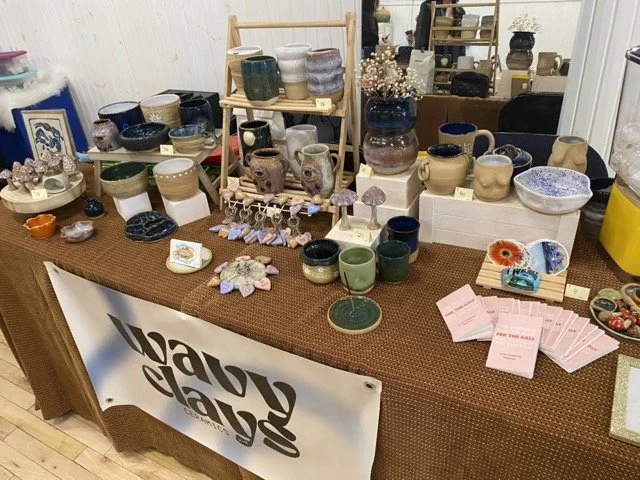
A recent table setup. I sorted pieces by price rather than labelling each piece. Time saver!
So how do you choose your first market? Start small. Local craft fairs, art walks, or seasonal markets are ideal. The application fees are usually manageable, but can vary by location, and the organizers often love giving new artists a chance.
If you can, visit a market before you sell at one. Notice how potters display their work, what catches your eye, and how they talk about their pieces. Notice what people pick up and buy, pick up and don’t buy, and what they tell you has caught their eye recently. This is what I like to call the “social choreography” of market day and it’s super important in helping you decide how you’d like to show up.
When you decide to apply, you’ll want a few details handy for a speedy process:
A short artist bio of about 150 words.
Photos of recent work or a description of what you intend to sell at the market.
A general idea of how much table space you’ll need (sometimes you have options).
I’ve applied for markets where I was asked upfront what payment types I would accept, if I had a preferred location for my booth, and all of my social media handles.
Every market application is slightly different, and having a few pieces of info ready will save you the dreaded last-minute scramble.
What to Bring To Your First Market
Congrats, you’re in! You’ve been accepted to the market and you’re filled with dread. No, wait, you’re thrilled, right? That’s the spirit! It’s okay to be a touch or a ton nervous, we’ve all been there.
As you prepare, know that it’s easy to overpack. Every potter I know has hauled way too much inventory “just in case.”
You need less than you think:
A tablecloth or drop cloth that fits your brand and doesn’t overpower your work
Simple display shelves or crates; height helps your work stand out
A mix of pieces at different price points, all clearly labelled
Business cards or tags with your social handles and website
Change box and card reader
Packing materials, bags, and newsprint/tissue paper
Water, snacks, sunscreen, patience, a friend…anything that makes your day comfortable
What you don’t need (yet): Elaborate signage and branding, or twenty variations of the same mug. Start with a table that reflects your artistic philosophy. Make it honest, functional, and easy to navigate.
Here’s a piece of micro-strategy: Get creative with your marketing materials. It’s a no-obligation way for people to engage with your work. I design my business cards as micro-prints and they are always gone by the end of the day. It’s a cost that I’ll gladly “eat” because it makes people happy to get a tiny piece of art for free.
The Money Part: Pricing Without Going into Analysis Paralysis
Money talk can make even seasoned artists squirm. It’s part math, part mindset, and part “don’t apologize for existing” garnished with “exposure doesn’t pay the bills.” Handmade work costs what it costs because it takes hours, days, weeks, and months to create. That’s a very long story kept very short.
Here’s what I learned the slow way:
Start with the real costs. Clay, glaze, firings, table fee, packaging, and yes, your time. Even if your practice is part-time, your labor counts.
Track your booth costs. That $100 table fee, $15 for bags, and $10 worth of card reader transaction fees are part of your overhead. See also: travel time, tape, display props, perhaps a morsel to eat so you can stay healthy while standing and chatting for 4+ hours, et cetera.
Don’t price emotionally. “Would I pay that much?” is the type of question that could send you into a self-doubt spiral. You made the art, so you’re no longer objective. Sorry. But a better question could be something like, “Does this price sustain the making of this art object?”
Round up with intention. Small price jumps often cover hidden costs (like packing materials and your website).
Keep notes. Track what sold, what didn’t, and what people picked up but put back. Patterns emerge fast.
When in doubt, ask yourself what feels respectful to the work, to your time, to your customers and community. That will take you some trial and error to figure out, but it’s the sweet spot.
Markets taught me that pricing is an ever-evolving conversation that you are leading, rather than asking for permission.
Managing Expectations and Energy
No one tells you how physically and emotionally weird market days can be. Maybe you’re outdoors (or under indoor lights), standing for hours, smiling through unpredictable weather, and sharing deeply personal work with strangers who are mostly polite and curious.
Some markets hum; others are quiet. Sometimes you sell out before noon; sometimes you don’t make booth rent. Both are normal.
What helped me set expectations that better fit me:
Set goals based on what you can control. “Sell everything” is what we hope for but it’s a rare pleasure, so focus on what you can influence.
Test your table setup a few days before the market. Snap a quick photo for reference on setup day.
Rest the night before, markets are typically 2-4+ hours long and sometimes over multiple days.
Eat and hydrate. Or bring a friend to keep you fed and hydrated.
Read your visitors. If someone is looking at your table and doesn't make eye contact, let them continue browsing and approach you first.
Go with the flow. If someone is chatting away and asking you a ton of questions, and seems genuinely interested in your work, then chat with them! You can meet a lot of interesting people at markets. Side note: This is more exciting to me than selling everything.
Write a short reflection afterward: Notice what went well, what to adjust next time.
Be a friend to your brain and don’t check your profit margin until you’ve unpacked and eaten dinner. Better yet, wait until the next day.
Markets can be exhausting and delightful. I once met a couple who called themselves “collectors of weird ceramics” and I wouldn’t have known that unless I put myself out there by asking, “What brings you here today?”

The lidded tentacle jar.
Then they bought one of my weird ceramics. A lidded jar with tentacles. Chef’s kiss.
I quickly realized that my people were out there, the ones who just get it. No belittling questions about the cost of the work, just appreciation.
But not everyone will buy or even appreciate your work. That’s totally fine and often it’s not really about you. It just makes the total gems who do appreciate your work that much more special.
Talking About Your Work Without Cringing
I used to dread the questions, “How long did this take?” “How did you make this?” and “What is that for?”
It always felt like a trap. But over time, I found ways to answer that did me and my art practice justice. Something like:
“Each piece takes several stages, from forming, drying, firing twice. The timing depends more on humidity than hours. Don’t even get me started on sourcing and testing materials!”
Often, people aren’t trying to interrogate you; they’re curious and trying to connect. The more you share your process, the easier it gets. Many people are amazed that you made the thing in the first place!
Not every interaction will lead to a sale. But a sale is not always the most valuable outcome of an interaction. Invite curiosity and see where it takes you.
The Quiet Payoff: Relationships Over Sales
Markets build community if you let them. You meet fellow makers, local customers, and the occasional curious kid who wants to know what every single piece at your table is for (mostly for snacks and flowers, tbh).
The most surprising part? Repeat faces. Someone who bought a mug in spring comes back in winter for a bowl. They tell you it’s their favorite cup and they want the bowl for their bestie. That kind of exchange can build real community.
As you participate in more markets, notice how every market becomes a checkpoint and a small measure of how your work, confidence, and systems evolve the more you show up with intention.
In Conclusion: What I Learned (and Still Relearn Every Time)
Markets are delightful and terrifying! Here’s what to focus on so you can feel good about showing up:
Preparation beats panic. Plan ahead and take notes.
Pricing gets easier when you stop asking for permission. You exist, you are an artist, you are more than enough. Repeat as many times as feels good.
Not every market is “worth it” financially, but many are well worth it for the lessons and community-building.
A good table setup is comfortable, balanced, and lets people navigate seamlessly (E.g. visible pricing, not too many or too few pieces).
Curiosity and engagement sells better than anxiety and silence.
And if none of this sticks, just remember: Enjoy the experience.
If you made it this far, thank you! Now I’m curious about your market stories. Drop the wins, the weather, and the weird questions below, or give us your best market prep tip.
More Like This
Explore more Wavy Clays Ceramics blog posts on studio life, balancing the 9 to 5, and building a creative practice that grows with you.