Why Are Handmade Mugs So Expensive?
Most people don’t think twice about the mug they use every morning. It’s just there.
Something to hold coffee, to warm your hands, to carry you into the day. Maybe you grab it while still half asleep and are just thankful it holds the right amount of coffee.
What’s easy to miss is how long that seemingly simple object took to exist.
Not hours. Weeks.
And not because it’s complicated, but because when it’s handmade it cannot be rushed without losing something essential.
So to explain why handmade ceramics cost more than what you’ll find at your local conglomerate, the real question becomes “how long does it really take to make a ceramic mug?”
The short answer is this: you can shape a handmade mug in under 30 minutes, but making it properly takes anywhere from one to three weeks.
The longer answer is where it gets interesting.
The Quick Answer
“Expensive” means something different to everyone. That’s a much bigger conversation where we would get into things like perception of value, the importance of creative work, and how you view money as a whole. Look at me fighting off a tangent already!
Here’s the quick and dirty (and incomplete) breakdown:
Active working time: 2 to 4 hours
Total process time: 1 to 3 weeks
This timeline is approximate and applies to a relatively simple handmade ceramic mug.
The moment you introduce texture, carving, wonky and fun handles, or glaze experimentation, that timeframe begins to stretch. Not because the work becomes harder, but because it becomes more attentive. Let’s build a more complete picture that does all handmade mugs some justice.
What Does It Really Mean to Make a Ceramic Mug?
A ceramic mug is not made in one sitting. It is built in stages, each one dependent on the material being ready. A ceramic mug is a functional object formed from clay, then dried and fired at high temperatures, often twice, to become durable and usable in your daily life.
The ceramic process is the full cycle of shaping, drying, firing, glazing, and refiring clay. Each stage requires specific timing and cannot be rushed without affecting the outcome.
This is why the process takes time. The material sets the pace. This process also requires a work space, whether you set up a home pottery studio or rent a space, that all factors into the final value of the artwork.
The Base Process (And Why It Takes Time)
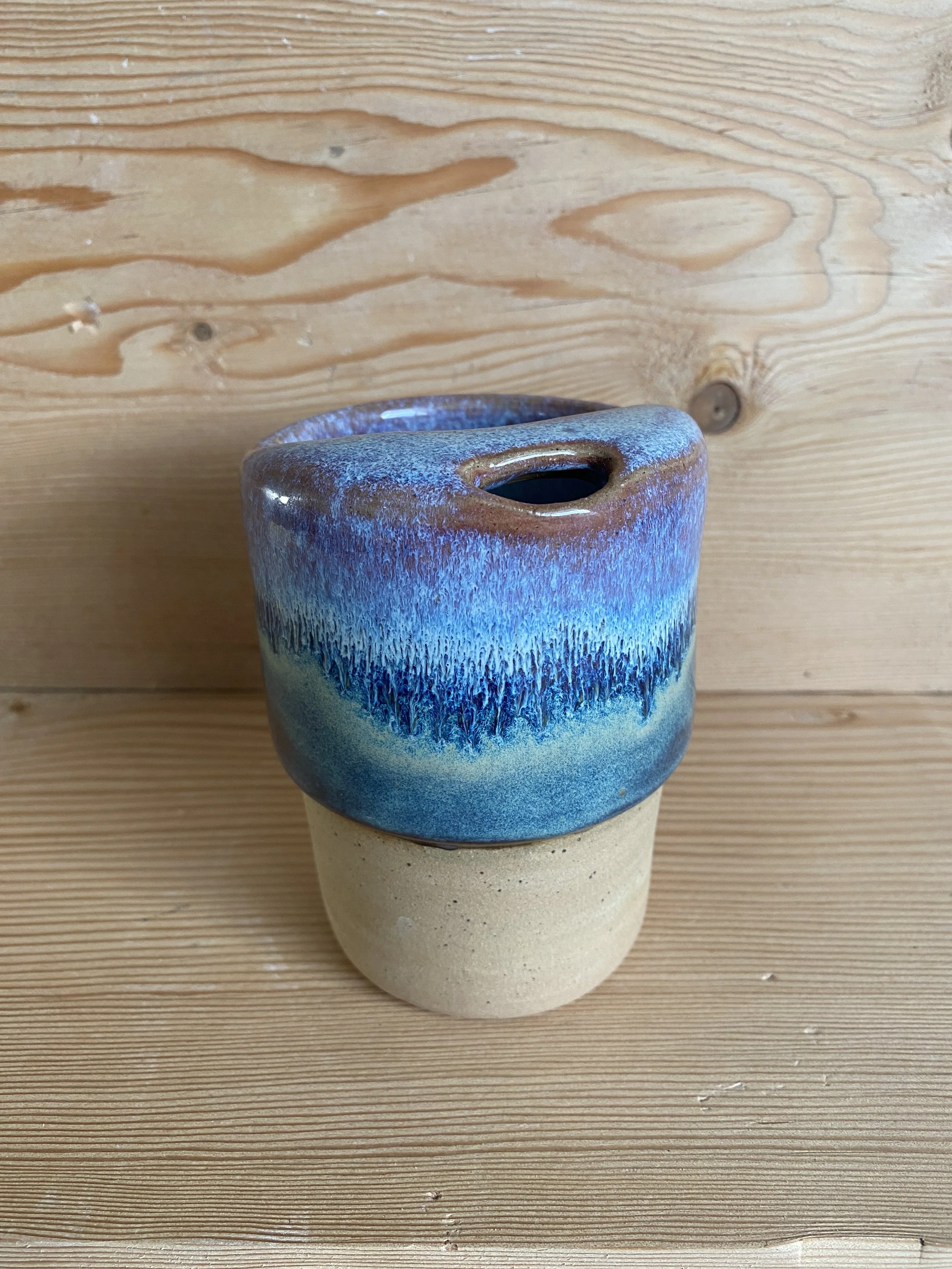
Travel Tumbler - 12oz
A coastal yet funky vibe on speckled clay. This glaze combo took many tests to get right!
At its simplest, making a ceramic mug involves:
Conceptualizing the mug idea
Preparing the clay
Shaping the form
Letting it rest to the right firmness
Trimming and attaching a handle
Drying fully
First firing
Glazing
Second firing
None of these steps are particularly fast or slow on their own.
But together, they create a rhythm that cannot be compressed without some risk.
Clay needs to firm up before it can be trimmed. Handles need equal moisture to attach properly. Pieces must dry slowly to avoid cracking. Kilns take time to heat and cool safely.
You can move quickly with your hands. You cannot move too quickly with clay. Things do explode in the kiln from time to time. Don’t worry, we’re used to it, I say, full of denial.
Why Drying and Firing Take So Long
The biggest factor in how long it takes to make a ceramic mug is not the making. It is the waiting, the planning, and the juggling (sometimes literally).
Drying alone can take several days. If rushed, the piece can crack or warp. The clay needs to lose moisture evenly, and that only happens slowly.
Firing adds another layer. A kiln cycle can take 24 to 48 hours, including cooling. Opening it too early risks damaging the work…but sometimes we get excited and open the kiln way too soon. We all deserve an unhinged moment.
There is a point where control ends and trust begins. Trust is just the best word I could find to sum up the result of knowledge and experience combining over many, many projects. This relinquishing of control is something all ceramic artists get familiar with, but it never really becomes something we’re truly comfortable with. Grief and anger are also a natural part of the ceramics process and I’m only half joking!
At some point, you stop working on the mug and start waiting with it. You’ll check on it daily, paying close attention to even the smallest changes in moisture. This is where a mug basically becomes a plant. You’ll care deeply for it and yes, you’ll also need to mist it occasionally.
Where Time Expands: The Details
A simple mug is only the starting point.
Some are carved with patterns that take hours to refine. Others are gently altered after shaping, pushed slightly off-center so they feel less uniform, more alive.
Handles might echo natural forms. A curve that feels more like a branch than a handle. A surface that catches light differently depending on the angle.
Then there is surface work:
Hand-carved textures
Layers of slip or underglaze
Multiple glaze combinations
Sanding and refining small details
Each step asks for pauses in between. The clay must pause, but you keep moving. Much to do in a ceramics process!
Clay has to reach the right dryness before carving. Glaze layers need time to settle. Adjustments happen slowly, often across days.
A detailed mug might require a few extra hours of work. But those hours are never back-to-back. They’re often happening over the course of days, layered between a lot of planning and maybe even some math! Yup, many potters are lowkey math whizzes.
Not All Ceramic Mugs Are Made the Same Way
Guess what? Form changes everything.
A classic mug is relatively straightforward, though even then, finding balance and comfort in making something “simple” takes practice, like we talked about earlier.
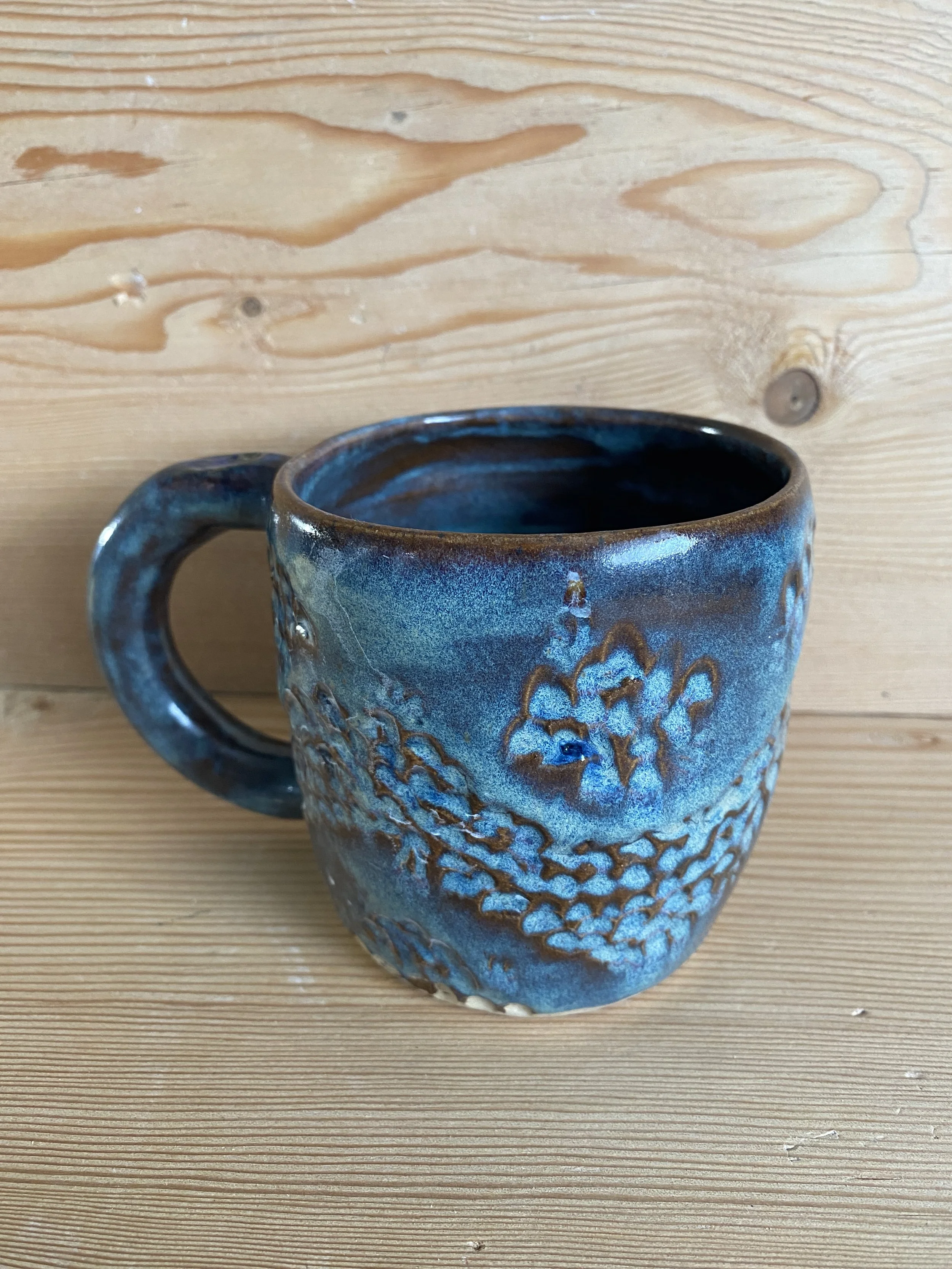
Chunky Mug with Chunky Handle - 14oz
A wheel-thrown, hand-carved, slow-dried, brush-on-glazed beauty.
But once you move beyond that, the process shifts to something even more complex.
A travel mug, for example, introduces new challenges:
Thicker walls for insulation, maybe even a double wall
Lids that need to fit precisely
Greater structural stability if there’s no handle
Even slowed drying time to avoid cracks in sculptural parts and joins
These are not small changes. They require testing, adjustment, and sometimes (okay, often) failure.
So when asking how long it takes to make a ceramic mug, the better question is:
What kind of mug are you holding?
The Time You Cannot See: Process, Practice, and Progress
Here is the part most timelines leave out:
A mug does not begin when the clay is prepared. It begins years earlier.
I still remember preparing for a market, opening the kiln and knowing, before touching anything, that something had shifted. A handle slightly pulled out of balance. A glaze that cooled in a way I had not expected. A decent batch, but not a perfect one, which is common.
A perfect batch happens, but it’s more like a pleasant and totally invigorating surprise that takes years of trial and error to achieve.
Every ceramic artist carries a quiet archive of attempts. Forms that collapsed. Pieces that cracked. Kilns opened with equal parts curiosity and hesitation. Sometimes you make an absolutely reckless chance and it goes your way. Sometimes you do everything right and things explode.
What can I say? It’s a humbling art.
Over time, your hands begin to understand things your mind cannot fully explain. When to push. When to stop. When to leave something alone.
A well-made mug reflects that familiarity. A habit that requires you to be fully present, intentional, and dedicated.
Handmade vs Mass-Produced Mugs
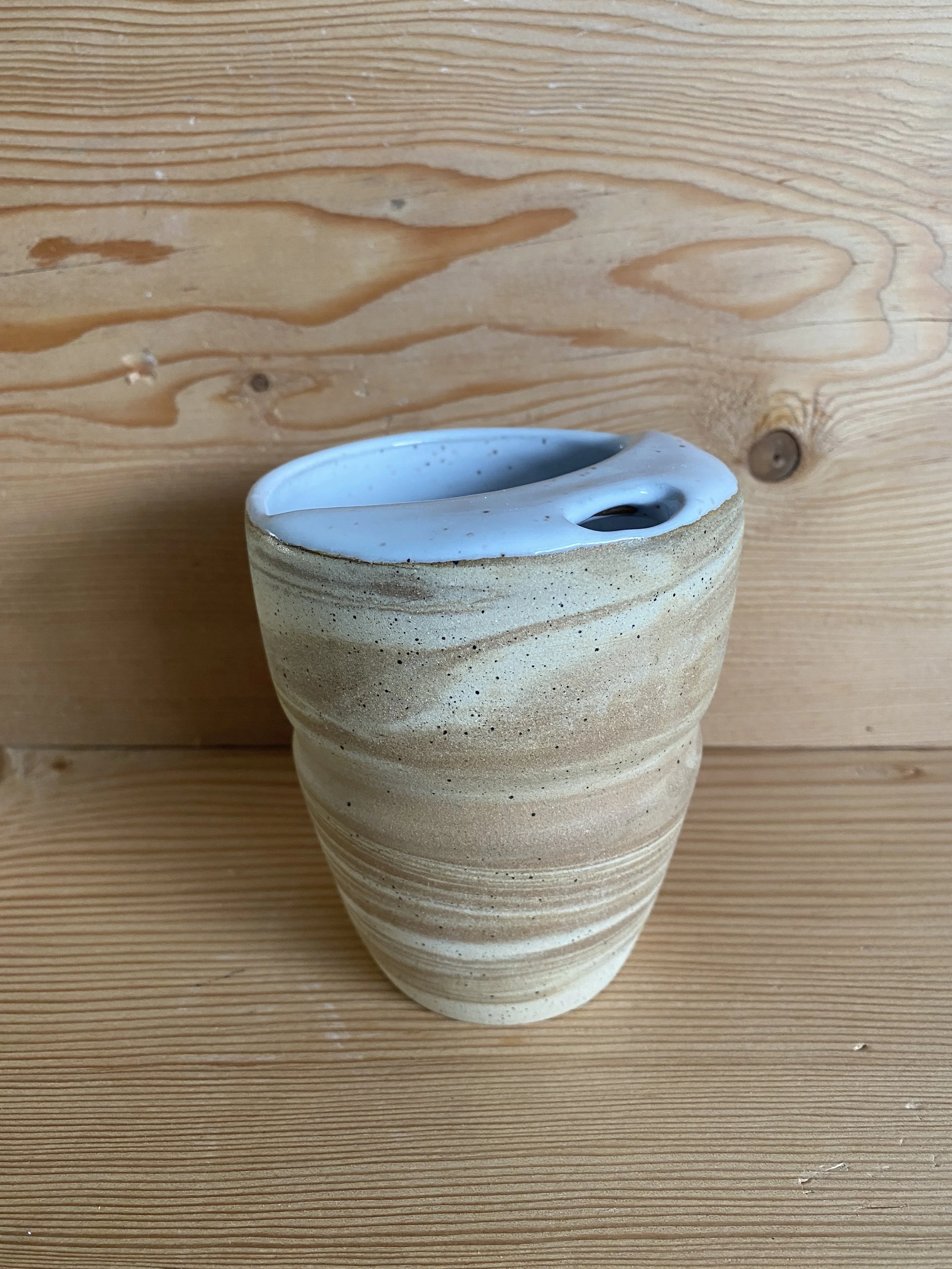
Marbled Clay Travel Tumbler - 12oz
This one was really fun to make. I experimented by marbling red and buff speckled clay. I glazed in inside white for contrast, leaving the marbled exterior unglazed for those who love a tactile moment. Anything marbled is naturally a one-of-a-kind ceramic piece.
Mass-produced mugs are designed for consistency. Same shape, same finish, same outcome.
A simple formula: fast, cheap, good enough. Imagine the work you do, regardless of what it is. If someone asked you to do it in half the time for a quarter if the cost, would your work maintain the same level of quality?
The reality is that cheap products usually aren’t cheap. Plot twist, I know, but the real cost is often hidden somewhere else in the process. Think labour, environment, regulations, and scale. A small business, a solo artist, simply can’t compete, and shouldn’t have to.
That’s why choosing handmade from a small business, if you can, supports a completely different system of work.
Handmade mugs are often made slowly using high quality materials, and their value reflects that.
Even within a small batch, each piece is unique. A glaze breaks slightly differently. A curve shifts just enough to be noticed. The surface holds small irregularities.
These are not flaws. They are traces of time. Of process.
In a world that moves quickly, most objects are designed to be replaced as quickly as we buy them. That’s why handmade ceramic art costs more than mass-produced ceramic objects.
Handmade art asks to be kept, sharing a story with every use.
So, How Long Does It Really Take?
If you measure strictly in time:
A simple ceramic mug takes 1 to 3 weeks
A more detailed or experimental mug takes longer
But that is only the visible timeline. And don’t let those well-edited 15 second videos fool you.
Behind it sits something harder to measure. Inspiration. Experience. Attention. Small decisions made over and over again, from the heart. Trial and error, lucky breaks, hydro bills, studio fees, material costs…you get the idea.
Final Thought
A ceramic mug holds more than tea or coffee. It holds timing. Process. A way of working that does not reward speed over care.
When someone chooses to collect a handmade ceramic mug, it is often because something about it feels right. Not perfect, but aligned. Unusual in a comforting way.
The weight. The texture. The way the handle fits your fingers just right. The way it holds warmth. These are all extremely intentional choices a ceramic artist makes. That is why it takes weeks to make something you might use in minutes. And once you start to notice that, the object shifts.
It stops being something you use without thinking and becomes something you return to, on purpose, as a meaningful part of your daily rituals. It becomes as much a part of your story as it is mine. And our stories are valuable well beyond cost.